In today’s rapidly evolving industrial landscape, high-performance permanent magnets play a vital role in driving technological innovation. Among the various magnetic materials available, neodymium iron boron magnets continue to stand out for their exceptional magnetic strength, high energy density, and wide range of applications. Often referred to as the “King of Magnets,” NdFeB remains one of the most important materials in modern manufacturing.
But what makes NdFeB magnets so difficult to replace?
Developed in the 1980s, NdFeB magnets are primarily composed of neodymium, iron, and boron. Compared with traditional ferrite magnets, they offer significantly higher magnetic performance and energy density. This allows them to generate a strong magnetic field in a relatively small volume.
For manufacturers, this advantage translates into more compact designs, reduced component weight, and improved motor efficiency. As industries increasingly demand smaller, lighter, and more powerful products, NdFeB magnets provide an effective solution for meeting these requirements.
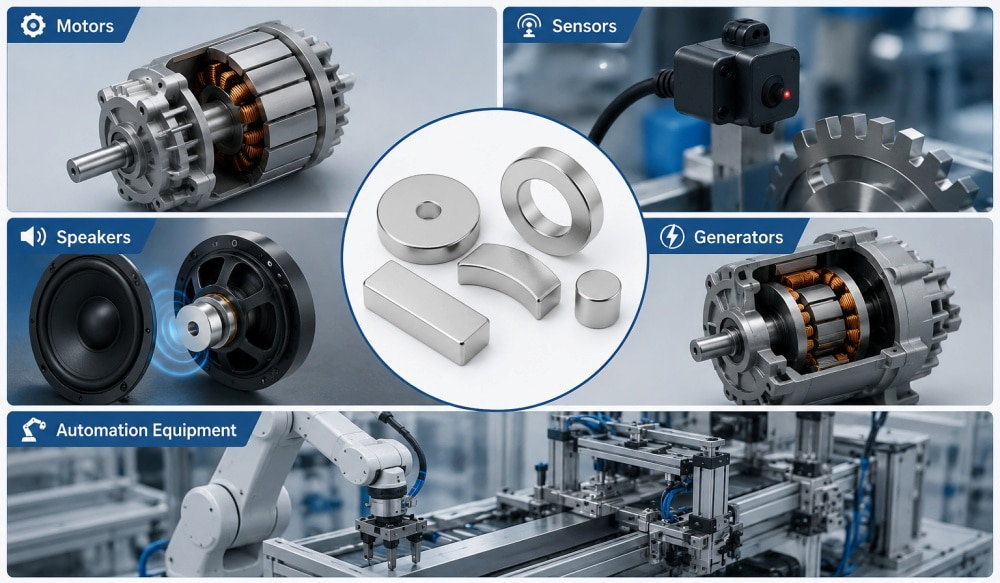
In the automotive industry, they are widely used in high-performance permanent magnet motors, including traction motors in many electric vehicles. In the renewable energy sector, NdFeB magnets are used in certain permanent magnet wind generators to support efficient energy conversion.
They also play an important role in industrial automation, robotics, precision instruments, medical equipment, consumer electronics, and smart home devices. As technologies such as humanoid robots and advanced automation systems continue to develop, demand for compact, high performance magnetic materials is creating new opportunities for NdFeB applications.
Despite their outstanding magnetic properties, NdFeB magnets face challenges, including temperature-related performance limitations, corrosion risks, and fluctuations in rare-earth material costs.
To address these challenges, manufacturers are continuously improving material formulations, grain boundary diffusion processes, protective coatings, and precision machining technologies. Selecting the appropriate magnet grade, temperature rating, and surface treatment helps ensure reliable performance under different operating conditions.
At the same time, reducing heavy rare-earth consumption, improving material utilization, and developing recycling technologies are becoming increasingly important for the industry's long-term sustainability.
From electric vehicles and renewable energy to robotics, industrial automation, and intelligent manufacturing, Neodymium magnets are driving innovation across a wide range of industries. Known as the “King of Magnets,” these high performance permanent magnets offer exceptional magnetic strength, high energy density, and excellent design flexibility, making them ideal for applications that require compact size, lightweight construction, and high efficiency. As magnetic materials technology and manufacturing processes continue to advance, NdFeB permanent magnets remain essential to the development of next-generation technologies. For manufacturers seeking reliable, high-performance magnetic solutions, NdFeB magnets offer significant advantages in improving product performance, optimizing energy efficiency, and supporting sustainable industrial growth.


 en
 de
 Hefei Super Electronics Co., Ltd.


 IPv6-Netzwerk unterstützt